Chi-Chi's
“Any excuse to fiesta.”
Episode 05 of Brands That Didn't Make It — a generative AI commercial series that takes brands which failed, folded, or quietly disappeared and asks what their advertising would look like if they relaunched today.
- Brand
- Chi-Chi's
- Status
- Vanished 20 years ago, first location recently reopened
- Campaign line
- Any excuse to fiesta.
- Format
- 30-second commercial built as a music video
- Original music
- Reggaeton-pop, written for the spot
- Focus
- Making food look delicious; a one-take reference-to-video build
- Role
- Concept, direction, character and location design, music direction, generation, edit
The brand
The Mexican chain that disappeared two decades ago and then, in a twist none of the other episodes got, actually reopened its first location. Of every brand in this series, this is the one with a real second act.
How it started
This episode began as a technical test with a narrow question: can AI actually make food look delicious?
Food is one of the hardest things to generate convincingly. The audience knows exactly what appetizing looks like and notices immediately when it's wrong. Cheese pulls, sizzle, steam, the specific gloss on a fresh margarita. Every one of those is a physics problem the model has to get right in a way a viewer feels rather than analyzes.
Somewhere in the cheese pulls, it turned into something else. The test kept proving the food could look great, and the food alone still wasn't a reason to go anywhere.
The problem
Casual dining advertising almost always sells the plate. Close on the entree, close on the drink, cut to a family laughing. The category is saturated with it and the food all looks the same at 30 frames a second.
Chi-Chi's real equity was never the plate. It was the room. Birthdays, sombreros, the whole table turning around. Nobody has a nostalgic memory of the food. They have a nostalgic memory of a night.
The idea
Any excuse to fiesta.
The restaurant where any reason is enough to celebrate. Chi-Chi's isn't selling dinner. It's selling the night you tell everyone about the next day.
That reframe moved the entire piece off the plate and onto the room, which also solved the technical problem. Food shot inside a party reads as appetizing because of the atmosphere around it, and atmosphere is something these tools are good at.
The format
Build the commercial as a music video.
High energy party music, food that looks incredible, real people having the kind of night they tell everyone about the next day. A music video is a format the audience already accepts as pure vibe, which means it can carry a positioning that has nothing to prove about the menu.
The film
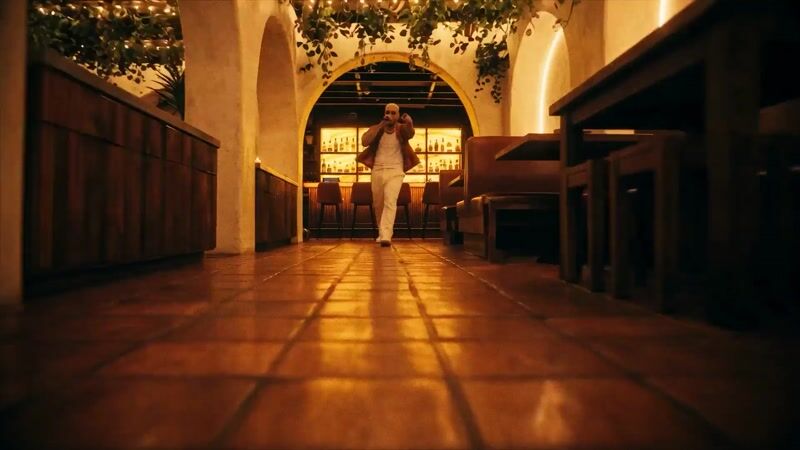
A fictional five-piece band called Los Fuegos performs an original track inside a packed, candlelit Chi-Chi's. The song is modern reggaeton-pop over a dembow beat with bilingual chant hooks, written in the Bad Bunny register. The camera never stops moving. The room is full and the food is everywhere.
The band
| Member | Role |
|---|---|
| Rey | Lead vocal |
| Yari | Vocal and percussion |
| Congo | Congas and timbales |
| Onyx | Keys and producer |
| Tito | Bass |
Each member got a full character sheet: a warm amber studio portrait, gold-toned, with a full-body pose plus a face-inset composite and name typography. Designing them as an actual band with actual instruments and actual personalities is what let them hold identity across thirty continuous seconds of performance. Five generic extras would have drifted inside four cuts.
The location
Cream plaster arches, terracotta tile floor, hanging pothos, string lights, LED-lit arch alcoves, an open live-fire kitchen, and an onyx backlit bar. Warm and candlelit throughout.
That lighting decision is also the food decision. Good food photography is a lighting problem before it's anything else, and a warm low-key room does more for a plate of enchiladas than any amount of prompting for "delicious."
The build
One 30-second Seedance 2.5 reference-to-video generation, with the finished audio track supplied alongside character and location references. The song existed before a single frame did, and the video was generated against it.
Three decisions did most of the work.
Fewer references, not more
The upload started at twelve references and got cut to nine.
Five location plates of the same room made the model read them as five separate rooms, and the geography drifted between cuts. Three plates that fully describe the space hold it together: the corridor axis, the bar-front symmetry, and the elevated wide. The group band photo got dropped as well, since the individual character sheets carry identity better and a fixed lineup pose leaks into every composition it touches.
Upload order is the prompt
Reference tokens are positional. If the files go up in the wrong sequence, every character mapping in the prompt points at the wrong person and the whole generation comes back scrambled with no obvious explanation.
The upload order is part of the build spec, written down and locked before anything gets submitted.
The first generation was boring, and generic camera language was why
The initial pass came back flat. The prompt described energy rather than specifying moves, and the model gave back exactly that: a competent, motionless-feeling performance video.
The rebuild replaced every vague direction with a committed, axis-specific one. Worm's-eye ground rushes. Body-mount chest rigs. Plate-height traveling shots. Overhead top-down beats. Frozen-crowd orbits. One decisive move per shot instead of a paragraph about vibe.
That is the difference between a spot that feels like a party and a spot that describes one.
Parallel model test
MiniMax H3 was tested against the same material as an alternate path. Its 15-second cap and native audio behavior make it a shot-per-generation tool rather than a one-take tool, which is a genuinely different way to build the same piece. Worth knowing which tool wants which architecture before committing to a build.
The stack
| Function | Tool |
|---|---|
| Concept, prompt development, reference architecture | Claude |
| Image generation | Google Nano Banana, OpenAI GPT Image |
| Video generation | Seedance 2.5 (MiniMax H3 tested in parallel) |
| Original music | Suno |
| Sound design | ElevenLabs |
What it proves
Here's the most interesting part I keep learning as I experiment more with generative AI. The generation was barely the last half of this. The other half was the same work any real production takes.
Landing on a strategy. Writing and rewriting the concept until it earned the idea. Building the shot list, the characters, the location scout, the sound design, the edit rhythm, the reason any of it should exist. The generation goes well because all of that comes first.
The planning and the creative development are still most of the job.
The tools are the crew. The thinking is still the job.