Fruit Stripe Gum
“Taste the Chaos”
Episode 01 of Brands That Didn't Make It — a generative AI commercial series that takes brands which failed, folded, or quietly disappeared and asks what their advertising would look like if they relaunched today.
- Brand
- Fruit Stripe Gum
- Status
- Discontinued 2024
- Campaign line
- Taste the Chaos
- Format
- 30-second spec commercial
- Timeline
- One weekend, concept to cut
- Focus
- End-to-end proof of concept; holding character design steady
- Role
- Concept, direction, generation, edit
The origin
Our team was reminiscing about Fruit Stripe Gum, the zebra-striped stuff that lasted about thirty seconds and tasted amazing while it did. Which led to a question worth actually answering: what would a Fruit Stripe commercial look like if they relaunched today?
I had been testing AI tools daily for about a year at that point. It felt like time to stop experimenting and build something end to end, to see what actually happens when you go from idea to execution fast.
The problem
Gum is one of the most generic categories in advertising. Fresh breath, confidence, someone smiling in slow motion, a wrapper spinning through the air. The work is interchangeable because the product truth is thin.
Fruit Stripe's real product truth was that it was wonderful and then it was over. Nobody builds a campaign on a flavor that quits. The brand's other asset was the zebras, mascots in the pure 1970s tradition: fun, weird, and completely disconnected from any product benefit.
So the brief becomes: how do you make a category-generic product ownable using a mascot that means nothing?
The idea
Give the zebras a civilization. Then destroy it.
The film
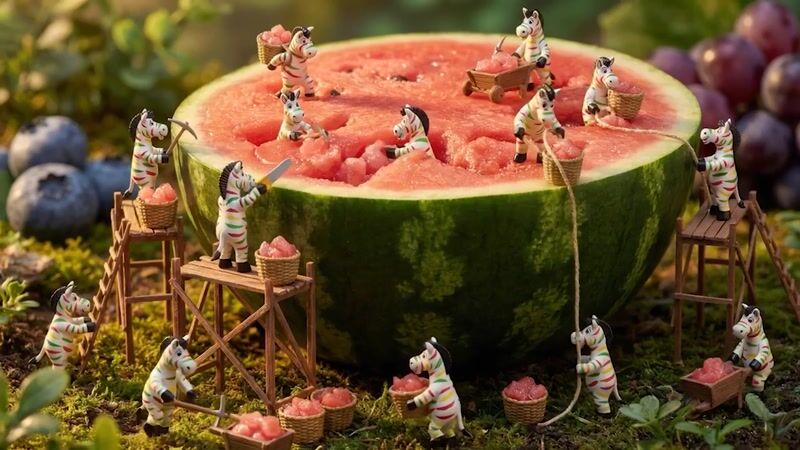
Miniature zebras farm giant fruit in a whimsical world they've built for themselves. They harvest, haul, and process it into gum with real care and real craftsmanship. You watch them work. You start rooting for them.
Then a giant human hand descends and levels everything.
Tiny zebras cling to the pack as it lifts into the air. Cut to a Gen Z chewer, blissed out, completely unaware of the civilization they just wiped out to get a stick of gum.
Why it works
Unexpectedness. The category has never once been dark. Dark comedy and surrealism in a gum ad is immediately ownable because no legacy brand in the space will go near it.
It speaks the audience's language. Absurdist humor is the native register for the people this category is trying to reach. Duolingo's unhinged owl and Liquid Death's entire brand exist because that tone is available and almost nobody uses it.
It turns the weakness into the joke. The thirty-second flavor becomes a feature. The whole world is disposable. That's the point.
The build
This was the proof of concept, and it's honest about its limits. The zebras aren't quite right. The motion is off in places. AI still struggles with fine detail and with holding a character's design steady across a shot list.
Character consistency was the hardest problem here and the one that most clearly needed a real pre-production process. Every episode after this one got full character sheets built as reusable assets with consistent lighting and multiple angles, which is the single biggest fix for drift. Episode 01 is the reason that step exists.
The music was written as a 90s-style jingle, which does a lot of the tonal work. The sweetness of the jingle running underneath the destruction is most of what makes the ending land instead of just reading as mean.
The stack
| Function | Tool |
|---|---|
| Creative strategy and development | Claude |
| Image generation | Google Nano Banana |
| Video generation | Wan, Kling |
| Music | Suno |
What it proves
For creatives, the change is in the iteration cycle. You can test five concepts in the time it used to take to visualize one. You can show an idea instead of describing it. You can find out what works before spending money on it.
For clients, that means seeing actual concepts rather than mood boards, testing directions before committing production budget, and making smarter bets on creative.
Great creative still requires strategic thinking, an understanding of human psychology, and storytelling. What these tools remove is the technical friction between having an idea and seeing it.
Also, it's fun.