Pan Am
“Room to breathe.”
Episode 07 of Brands That Didn't Make It — a generative AI commercial series that takes brands which failed, folded, or quietly disappeared and asks what their advertising would look like if they relaunched today.
- Brand
- Pan Am
- Film
- The Space
- Status
- Airline shut down 1991
- Campaign line
- Room to breathe.
- Format
- 90-second spec commercial
- Focus
- Pushing performance and horror in AI video
- Role
- Concept, writing, direction, generation, edit, color, sound
The brand
Pan Am put the jet age on a poster. It launched the 747, painted a blue globe on the tail, and made flying feel like the most glamorous thing a person could do. The airline stopped flying in December 1991.
How it started
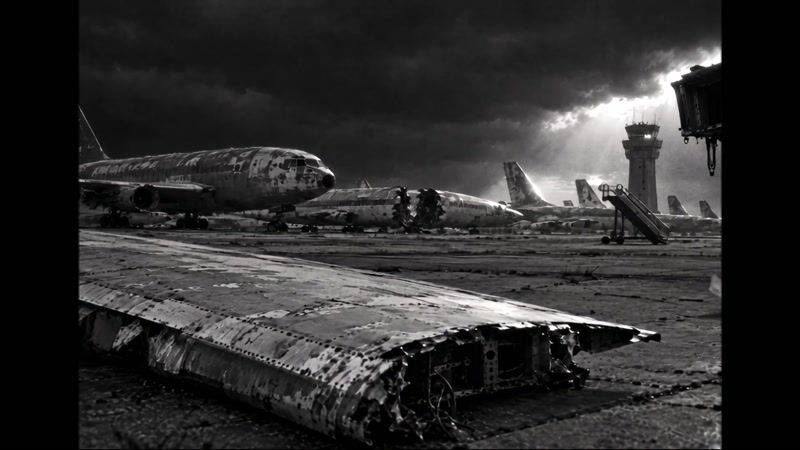
For Halloween I wanted to experiment more with horror and make something a little spooky with AI. It turned into a Pan Am spot set in a haunted airport during a thunderstorm.
It's a ridiculous idea. I loved it from the first sentence and decided to commit all the way: real production design, real lighting logic, a real score, and a finish I'd put on a reel. It came together with Seedance, ElevenLabs, Claude, and a final edit in Premiere Pro.
The idea
Play airline heartbreak as a Greek tragedy.
A grown man mourns every airline that ever let him down as if each one broke his heart. His therapist has exactly one suggestion.
The film
The film is called The Space. A grown man grieves at full operatic volume in a therapy session. The haunted airport around him is the inside of his head, every cramped seat and missed connection and broken promise from the airlines in his life turned into a physical place. Mannequins fill the seats. Lightning cracks across the windows. His therapist takes notes and never moves. Then she asks him one question, and he falls backward out of black-and-white and into a sunlit Pan Am first-class suite.

The joke
Walter never says plane and never says airline. Everything he says sounds like he's been dumped.
"They promised they'd be there for me." "They left without me." "There was never any room for me."
His therapist, Mrs. Lind, answers in one or two flat words. "And?" "Go on."
The punchline is the only question Lind asks all session. She stops writing, takes off her reading glasses, looks at him for the first time, and lets two full seconds of rain fill the room. Then, flat as a tea recommendation: "Have you tried Pan Am?"

He freezes mid-wail, blinks twice, and tips backward. He lands in the same profile on a lie-flat bed, in color, legs stretched all the way out. Lind is there too, now a Pan Am flight attendant, and for the first time she smiles as she hands him a glass of champagne. The super reads "Room to breathe."

The build
As a live-action shoot this spot is a big ask. A soundstage gate lounge dressed with aircraft wreckage. A rain rig and lightning units. A gutted airliner cabin, a boneyard of dead jets, a 747 first-class suite, dozens of mannequins, and an air-to-air plane shot at sunset. Any producer would cut half of it in the first meeting, and the idea would get smaller with every cut. None of those meetings happened, so I kept every wild piece.
All the video is Seedance 2.5. I picked it after running the same scene and references through Kling 4.0 head to head. About 45 reference stills came out of GPT Image 2.5, covering character sheets, location plates, props and wardrobe. Every select went through Topaz to get it up to delivery resolution.


Each take was cheap enough that I could shoot coverage and try the weird angle, and when an idea didn't land I threw it out.
The look
I directed the whole thing in the grammar of Yorgos Lanthimos. Rigid symmetry. Fisheye and wide lenses that bend the room. Slow mechanical zooms in place of dolly moves. Hard cuts and long, uncomfortable silences. Absurd lines delivered completely straight.

The film lives in two worlds that never share a frame.
| The haunted airport | Pan Am | |
|---|---|---|
| Look | Black-and-white 1960s studio noir, coarse grain | Warm, clean color full of sky |
| Frame | 4:3 | Full 16:9 |
| Light | One hard source, no fill, lightning strobes | Soft sun, open shadows, sunset over clouds |
| Camera | Walter's camera never stops moving; Lind's never moves | Lind gets her first and only push-in when she smiles |
| Brand | No logos anywhere | Pan Am is the only real brand mark in the film |


The storm came in after the first few takes, when I wanted the scenes to feel bigger. Every black-and-white scene got the same weather: rain lashing the gate windows, lightning throwing razor-sharp mullion shadows across the floor, thunder rolling under the dialogue, water dripping from a torn ceiling panel, oxygen masks swaying in the draft. It gave the noir lighting a real, moving source, and it made the clear sky in the color half feel like relief.
Consistency came from prompt craft. These rules went into every prompt:
- Every reference image gets one clear job.
- Every character and set block is pasted word for word into every prompt.
- Light gets described concretely. "Bars of light from a venetian blind at frame left," never "moody lighting."
- Stage directions stay out of quotes. Seedance will speak anything that looks like speech. A wail "echoing off concrete" came back with Walter shouting "Concrete!"
The performance
Pushing performance was the most fun part of this project. I wanted Walter close to Shakespearean, with huge, sincere grief, a man playing his own tragedy to the back row of an empty airport. Lind is formal, flat, and perfectly still. The comedy comes from putting those two in the same room and refusing to wink.
Seedance generates dialogue natively, so each voice was written as a fixed description and repeated word for word in every prompt:
- Walter: a deep, warm, soft American baritone with a slight rasp, slow and breathy, close to tears
- Lind: a low, cool, precise voice with a Received Pronunciation accent, every word clipped short


The mannequins
Every story needs an antagonist, and ours is the mannequins. Each one stands in for a different airline that broke Walter's heart. They sit stiffly in grey suits and fedoras, or stewardess uniforms and pillbox hats, filling the seats of the airport in his head. They're everywhere and they never help.
This is where the horror side really opened up. I wrote a set of rules and pasted them into every prompt:
- The mannequins only move in the dark between lightning flashes, so each flash finds them somewhere new.
- On screen, they only turn their heads, in tiny synchronized jerks with a plastic creak.
- Walter never speaks in these moments and plays it real: frozen, holding his breath.
- No blood, no gore, no monsters, no stingers. Only the mannequins, the storm, and silence.
A pale mannequin head rises slowly over Walter's shoulder and stares into the lens. Mannequin faces press against every window of a dead jet in the boneyard, then vanish in the next flash.


Nothing jumps out at you. It's polite and deeply wrong, which is my favorite kind of scary.
The score
None of the video generations have music in them, which left the score wide open. I built it in ElevenLabs, and the music is what ties the two worlds together.
The airport gets a horror score made from unusual instruments that create anxiety: a hurdy-gurdy drone with contrabass clarinet, bass harmonica, and scraped double bass. It sounds like an airport groaning. The fall into Pan Am gets a neon sunset synthwave cue with a key change and a big final chord.
The horror score and the synthwave sunset sit at opposite ends of the spot, and that contrast does as much storytelling as the switch from black-and-white to color.
The finish
AI gave me a big bank of footage. The film got made in Premiere Pro.
I shot every scene like coverage on a real set. Each generation kept the same blocking and the same lines, with new camera angles and new inserts every pass: a wide master, over-the-shoulders, low angles, fisheyes, a hand in a rain puddle, a pen stopping on the page. I cut across passes and took the best two to four seconds from each.
The finish was hands-on:
- Edit: the rhythm of the stillness, the long silences, and the hard cut on the fall into color
- Color: final grade with LUTs, pushing the noir contrast in the airport and the warm sunlit look on Pan Am
- Grain: a heavier film texture to sell the 1960s black-and-white
- Crop: reframing shots to tighten the symmetry
- Sound: all the sound design and the final mix, sitting thunder, rain, creaking mannequins and dialogue against the score
The end card was its own small project. The plate is a close shot of the Pan Am globe on the tail against a sunset. Image models kept redrawing the photo, so Claude and I coded the animation by hand: two blue cheatline stripes sweep in from the left and curve into the globe, then "Room to breathe." rises above them. It rendered with alpha and dropped straight onto the footage in Premiere.

Working with Claude
Claude was my production partner from the first draft of the script to the end card. It helped develop the concept and the world, wrote and revised prompts from my notes, and reviewed takes with me so I could keep moving. I'd give a note in plain language and have a new take to look at a few minutes later, which kept the whole project feeling like a set with a fast crew.
The stack
| Function | Tool |
|---|---|
| Image development | OpenAI GPT Image 2.5 |
| Video generation | Seedance 2.5 (tested against Kling 4.0) |
| Dialogue | Seedance native voice |
| Music | ElevenLabs |
| Upscaling | Topaz |
| Production partner | Claude |
| Edit and finishing | Adobe Premiere Pro |
What it proves
Write it like a film and the model starts behaving more like a crew. The production bible for this spot had camera rules, lens choices, a weather system, and locked character blocks, and that document did more for consistency than any prompt trick I've found.
The idea never had to shrink to fit a budget. Every piece a producer would have cut in the first meeting is on screen. That's the part I keep coming back to from the operator seat, because the expensive part of this spot was the thinking and the finish.
The Space is an unofficial spec piece. Pan Am's name and livery belong to their trademark holder, and this work has no affiliation with the brand.