RadioShack
“You don't know why you need us. Until you do.”
Episode 06 of Brands That Didn't Make It — a generative AI commercial series that takes brands which failed, folded, or quietly disappeared and asks what their advertising would look like if they relaunched today.
- Brand
- RadioShack
- Status
- Original company filed for bankruptcy in 2015; the brand lives on
- Campaign line
- You don't know why you need us. Until you do.
- Format
- 30-second spec commercial
- Focus
- Directing human behavior and performance in AI video
- Role
- Concept, direction, character and world development, generation, edit
The brand
RadioShack was the place you went when something stopped working and you had no idea what the little piece inside it was called. Somebody behind the counter did.
The brand still exists. This episode revisits the neighborhood electronics specialist that made the name mean something in the first place.
How it started
After experimenting with food, period worlds, animals, and music videos, I wanted to spend more time on people.
Specifically, performance. A character listening to someone else. Trying something that fails. Realizing they need help. The small physical changes that let you understand what someone is feeling before they say it.
A hospital drama felt like a good place to test that. Everybody needs something immediately. Every answer changes what happens next. And the audience already knows what this kind of scene should feel like.
The problem
A wall of batteries and adapters is a difficult thing to build a commercial around. Most of those things only become interesting when you need one.
That was the opening. Take a very small electronics problem and give it the stakes of a medical emergency. Make the person who knows how to fix it the most important person in the room.
The idea
Give the electronics guy the hero entrance.
A surgical team is running out of options. The specialist they need works at RadioShack.
The whole thing depends on the team believing the emergency. Nobody gets to signal that they know how ridiculous this is. The audience gets the joke when it sees what everyone is trying to save.
The film
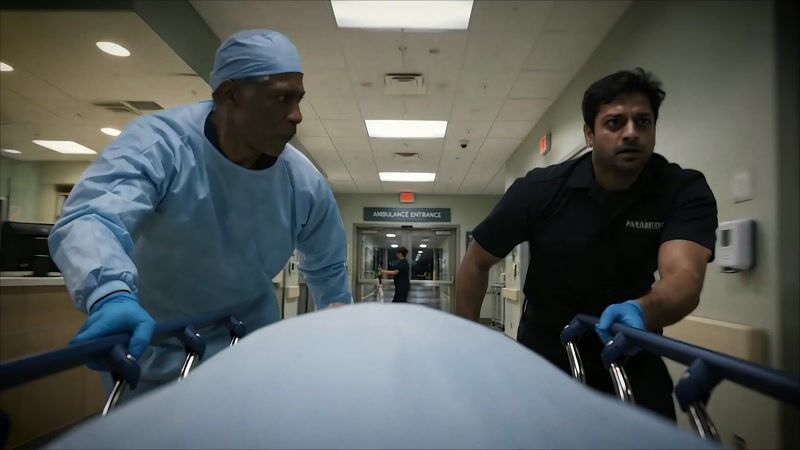
A gurney races through a hospital corridor. In the operating room, the surgeon and nurse work over something we cannot see.
"Check the leads." "Already checked." "Again."
The language could belong to a patient or a piece of electronics. The framing keeps us from deciding which.
The team reaches the end of what it can do.
"Get me RadioShack."
A red polo, surgical gloves, and a hero entrance far bigger than the job title would suggest. Then we meet the patient: a broken game controller.
A tiny replacement contact. A repair. A light comes on.
"It's what we do."
The build
"Urgent" describes what I want the audience to feel. It leaves the model to invent how every person behaves.
Does the surgeon shout? Move faster? Freeze? Look at the nurse? Keep working while he talks? Those are different performances, and they tell different stories.
The useful work was getting specific about what each character wanted, what they were doing to get it, and what changed when it failed.
The surgeon needs a response. He starts by directing the nurse, takes over when the checks fail, then has to ask for help.
The nurse needs her assessment to be trusted. She looks at him, answers directly, and checks again. She has work to do. An eye roll would turn the moment into an argument.
The RadioShack employee needs the team to recognize that he has the solution. His attention stays on the job even when the camera treats him like a movie star.
Give the emotion something physical to do
The hardest work in this film is hidden. The patient stays below the frame until the reveal, so for most of the runtime the audience reads the emergency off faces, voices, and hands it cannot see.
The emergency could be as big as the genre demands — compressions, movement, pace. The repair could not. Hidden work is where a prompt leaves the most undecided, and undecided hands drift toward generic emergency behavior. The direction described the actual task: a delicate connector adjustment, a pencil grip, fingers and wrist moving while the shoulders stayed level. The camera could be chaotic. The person still had to do the right job.
The three examples below quote the actual wording from the later prompts; the emotional labels are the shorthand they replaced.
Urgency: give the hands a specific job
The shorthand was "the nurse is urgent." The prompt instead:
The nurse checks the controller's connector below frame with one brief pinch, a slight wrist turn, then a release. She finishes the check and holds still while watching for a response.
There is a task, an end to that task, and a moment of waiting. The actor has something specific to do even though the camera cannot see her hands. That keeps the physical performance connected to the object being repaired.
Frustration: make the other person register the answer
The shorthand was "she is frustrated that he isn't listening." The prompt, for "Already checked":
Firm and immediate, with emphasis on "already." She needs him to understand that the check has been completed. Hold his eyeline through the end of the sentence; no eye roll.
The objective is to make him acknowledge her assessment. That gives the eye contact and emphasis a purpose. An eye roll would tell a different story about their relationship.
Running out of options: change the behavior before the line
The shorthand was "the surgeon is worried." The prompt:
His eyes track the controller's connection below frame. He makes one tiny tool adjustment with his wrist, then his fingers become still.
His lips press together. He takes one tight breath through his nose. The camera brakes imperfectly and stays close enough to register his jaw tightening.
Then, for "Not with what we've got":
Quieter than his commands, compressed and quick. He speaks while still looking down. The failed assessment forces him to redirect his attention.
He tries something, gets no response, and has to change course. The line comes out of that failed attempt. Making it quieter gives the scene a change in pressure; every line at maximum volume would lose that progression.
Direct what happens between the lines
Dialogue can sound convincing while the scene around it feels empty. Someone delivers a line, waits, and delivers another one.
I wanted the characters to affect each other. The nurse's failed check makes the surgeon take over the fine adjustment. Her question makes him assess the problem. His inability to fix it creates the need for the specialist.
That means describing attention as carefully as speech. Where are the eyes? What are the hands already doing? Does the character answer immediately, or do they need a moment to realize something first?
A useful way to write a performance beat is: what they want, what they do, what changes, and how that changes the next line.
Only specify the physical details that carry that beat. A long inventory of blinking, swallowing, nodding, and breathing can become its own kind of empty performance.
Give the line something to come out of.
The camera has to let us see it
The prompts also got more specific about the camera's behavior. Whip toward the person answering. Brake. Find their face. Let the line finish.
If a character's realization happens during a blurred pan, the direction may be in the prompt but it is missing from the scene the audience sees. The moving camera needs moments of clarity.
The same applies to sound. Rattling wheels, quick breaths, gloves, shoes, and hospital activity can build pressure around a quieter line. Every character does not have to shout for the room to feel urgent.
The hero changed during development
The original treatment had an older, understated employee who had been beside the team all along. Later iterations moved toward a younger employee and a much larger entrance: bright backlight, a low camera, movement, and a red polo cutting through the hospital palette.
That changed the scale of the reveal. The performance still needed a simple objective: get the team what it needs. The character got to be heroic, then useful.
Build the world around the performance
Character references established faces and wardrobe. Location references established the corridor and operating room. Prop references tracked the controller from its exterior to the damaged battery compartment, the replacement contact, and the powered-on state.
Those references answered continuity questions. The performance directions still had to tell the characters how to use that world.

In the OR, the direction held the actors at a fixed body height with steady shoulders and bent elbows. Small finger-and-wrist movements did the work; eyes, jaw, breath, and vocal delivery carried the concern. The controller stayed outside the composition.
Concealment needed the same specificity. A prompt saying "don't reveal the patient" does not establish where the camera can look. The revised arrival placed it below the gurney rail, with the drape physically blocking its view of the bed.

The cast
Three characters, each with a full-length casting reference: identity and wardrobe established once, then reused across every generation so the person in the corridor is the same person at the reveal.


The stack
| Function | Tool |
|---|---|
| Image and reference development | OpenAI GPT Image |
| Generation workspace | Higgsfield |
| Video generation | Seedance 2.5 |
| Voiceover and sound effects | ElevenLabs |
| Music | Suno |
| Edit and finishing | Adobe Premiere Pro |
What it proves
Emotion words are not direction. "Urgent" tells the model what the audience should feel and leaves the entire performance undecided. An objective, a physical task, and a change — that is direction, and the model responds to it the way an actor does.
The other half of the proof is the work the camera never sees. Hands below the frame still need a defined task; leave them undecided and the model reaches for the genre's stock behavior instead of the story's.
And the directing vocabulary transfers. What a character wants, what they do to get it, what changes when it fails — that framework moved from live sets to generated ones without modification.
What I'm learning
This is still an experiment. A detailed prompt is a set of directions to test. The take has to be judged by what actually made it onto the screen.
What interests me most is how familiar the questions are becoming. What does this person want? What just changed? Why do they look away? What makes them stop moving?
Those questions have always been part of directing people. They are becoming a more useful way for me to work with generated people, too.
"Urgency" is a starting point. A surgeon whose fingers stop because the last adjustment failed is a moment you can build a scene around.
That is the part I want to keep experimenting with.